Salt-Free vs. Traditional Water Softeners: Which Is Better for Florida Homes? Hard water is one of the most common complaints for Florida homeowners. You may notice white buildup on faucets, cloudy glassware, soap that does not lather well, dry-feeling skin, stiff laundry, or scale around appliances and fixtures. Over time, hardness minerals can also affect plumbing, water heaters, dishwashers, washing machines, and tankless water heaters.
When homeowners start looking for solutions, they often come across two main options: traditional salt-based water softeners and salt-free water conditioners. Both are used to address hard water problems, but they do not work the same way.
Understanding the difference can help you choose the right system for your home, budget, and maintenance preferences.
What a Traditional Water Softener Does
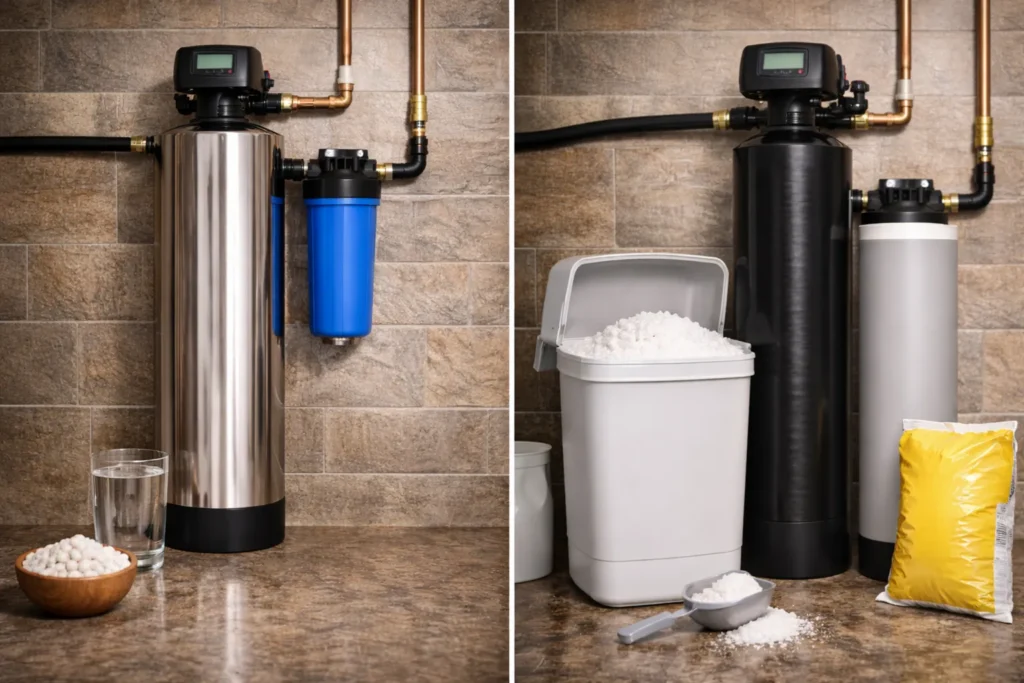
A traditional water softener uses a process called ion exchange. In simple terms, the system removes hardness minerals like calcium and magnesium from the water and replaces them with sodium or potassium ions.
This is why traditional softeners are often effective when the goal is truly “soft” water. Many homeowners notice softer-feeling showers, better soap lather, fewer spots on dishes, and reduced mineral buildup.
Traditional softeners are a strong option for homes with significant hardness issues. They are especially useful when homeowners want to reduce scale and improve how the water feels throughout the house.
The tradeoff is maintenance. Salt-based systems require salt or potassium to be added periodically. They also go through regeneration cycles, which use water. For some homeowners, that routine is not a big deal. For others, carrying salt bags and managing maintenance is something they would rather avoid.
What a Salt-Free Water Conditioner Does
A salt-free system is different. It does not remove hardness minerals the same way a traditional softener does. Instead, many salt-free systems condition the minerals so they are less likely to stick to surfaces and form scale.
That means a salt-free conditioner may help reduce scale buildup in plumbing, fixtures, and appliances without adding sodium to the water and without a brine tank.
For Florida homeowners who are mainly concerned about scale, tankless water heaters, low maintenance, and avoiding salt handling, salt-free treatment can be appealing.
However, because salt-free systems do not remove minerals in the same way, the water may not feel as “soft” as water from a traditional softener. Soap feel, shower feel, and laundry results can differ depending on the home’s water chemistry.
Which One Is Better?
There is no single answer that fits every Florida home. The better choice depends on what is actually in your water and what problem you want to solve.
A traditional water softener may be a better fit if you want softer-feeling water, better soap performance, and a proven solution for hardness minerals.
A salt-free conditioner may be a better fit if your main concern is scale reduction, lower maintenance, no salt bags, no brine discharge, or protecting appliances from buildup.
Some homes may need more than one type of treatment. For example, a home with hard water, chlorine taste, iron, sulfur odor, or sediment may need a customized system that includes filtration along with softening or conditioning.
That is why testing matters before choosing.
Florida Water Can Vary by Neighborhood
One reason homeowners get confused is that water quality changes across Central Florida. City water and well water are not the same. Even two wells in the same general area can have different levels of hardness, iron, sulfur odor, sediment, pH, and total dissolved solids.
In some areas, the biggest complaint is hardness. In others, odor or staining is the issue. Some homeowners want better drinking water at the sink, while others want to protect the whole home.
A neighbor’s system may not be the right system for your house. Water treatment should be based on testing, not assumptions.
Maintenance Should Be Part of the Decision
Homeowners should also think about the maintenance they are willing to do.
Traditional softeners typically require salt refills and system checks. Salt-free conditioners are often lower maintenance, depending on the specific system and water conditions. Reverse osmosis systems need filter and membrane replacement. Whole-house filters may also need periodic service.
There is nothing wrong with maintenance when it is expected. Problems happen when homeowners buy a system without understanding what it needs to keep working properly.
Protecting Plumbing and Appliances
Hard water scale can build up inside fixtures, appliances, and water heaters. That buildup may reduce efficiency and shorten the life of equipment over time. For homes with tankless water heaters, scale prevention is especially important because mineral buildup can affect performance.
Both traditional softeners and salt-free conditioners can play a role in protecting the home, but the right choice depends on the water test results and the equipment in the house.
Start With a Free Water Test
RainKing Systems helps Florida homeowners compare water softening and salt-free options based on their actual water. If you are seeing buildup, stains, spots, dry skin, or appliance issues, the first step is not guessing which system to buy. The first step is testing.
With a clear water analysis, RainKing can help determine whether your home is better suited for a traditional water softener, a salt-free conditioner, whole-house filtration, reverse osmosis, or a customized combination.